
Recent years have seen an explosion in popularity for true crime stories and dramas, with programmes such as Line of Duty and Making a Murderer dominating our televisions and our streaming services, and ITV have not been slow accommodate the gritty and macabre.
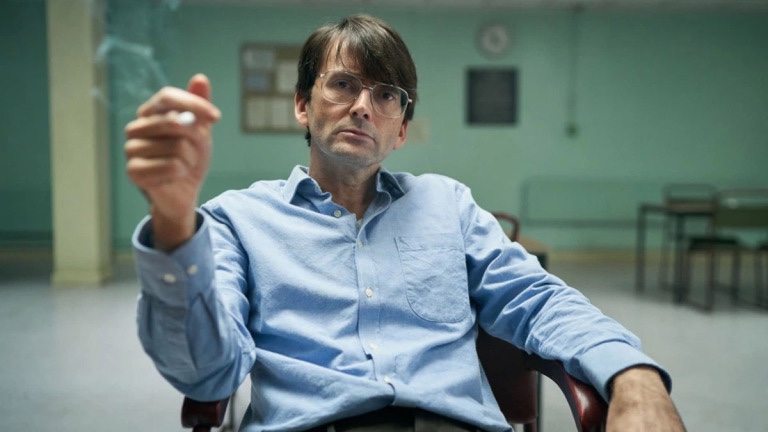
Mostly recently, of course, has been Des, the Lewis Arnold-directed miniseries based on the horrifying true story of Dennis Nilsen, alias Des – boiled heads and all.
With any true crime biopic, there needs to be a good balance between reality and entertainment and Des managed this well, especially with an outstanding performance from David Tennant as serial killer Nilsen. Tennant’s portrayal is not only chilling but witty, making Des grimly likeable in such a way that many killers have been over the years. With a razor-sharp wit and a subtle calmness Tennant makes the performance all the more captivating for the darkest of reasons. Opposite Tennant is Daniel Mays as DCI Peter Jay, a great boulder of a man with a strict sense of right and wrong and a desire to seek justice for the 15 victims of Nilsen. Mays once again gives a performance that is worthy of his past at the Royal Academy of Dramatic Arts. Jay is not necessarily a likeable character, but opposite the sarcastic and darkly charismatic Des he is a personification of the conviction of the British justice system and Mays brings a fierce intensity and desperation to the pursuit of justice.
There are undoubtedly a few pacing issues within Des, mainly due to the three-episode running time. Moments of dragging legalities are punctuated with sharp moments of grisly murder detail, but over three episodes this can seem almost jittery. I understand that anything less than three episodes would have not been enough, yet any more would have potentially lost the edge that the series clearly has. Within the framework of a miniseries it generally works pretty well.
One thing I noticed across the series was the accompanying score, written by Sarah Warne. Most notably, it utilises long, dragging strokes on cellos to accent moments of particular tension or revelation. This works in much the same way as Jonny Greenwood’s score for the 2007 film There Will Be Blood, allowing the score to compliment the drama unfolding visually. It certainly directs the viewer to notice a piece of information much more closely than potentially otherwise, giving the impression that you personally are pursuing the case.
Des has a neo-noir style to it, set in the grey days of Thatcherite London – something which is mentioned by Nilsen several times throughout – and this gives the series an eerie atmosphere, especially when paired with Warne’s score. Refusing to portray London as a hub of eighties fashion and culture, it is reminiscent to ITV’s Whitechapel, choosing to portray police work as not so glamorous as we have been led to believe. This is not a nice world to be in.
With any true crime story that has been analysed, reported and portrayed, the story is already there to be uncovered. The trick is to show an old story in a new light, and I think that with the performances alone this was achieved. The story of Dennis Nilsen is an infamous one in the annals of modern British crime and is fixed in the dark imaginations of the British public that has conceived a fascination with the gruesome side of humanity since the days of the Ratcliffe Highway murders. Des is brutally grim and thoroughly entertaining, if not a little dark. To the seven viewers who reported complaints to Ofcom over the murderous details of Des, I say grow up. This is crime history as it happened and is a pretty gripping watch for anybody interested in detection and murder.
A Crime Revisited: ITV’s ‘Des’
 Build the Scene Reviews